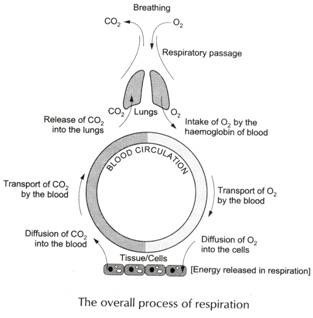
In a simple way , Breaking Down of various nutrient Glucose , Protien with the help of oxygen (O2) gsa Known as Respiration.
OR
A process in living organisms involving the production of energy, typically with the intake of oxygen and the release of carbon dioxide from the oxidation of complex organic substances.


TYPES :-
- Aerobic respiration .
- Anaerobic respiration .
1. Aerobic Respiration :-
Aerobic respiration is the process by which organisms use oxygen to turn fuel, such as fats and sugars, into chemical energy. In contrast , anaerobic respiration does not use oxygen.

2. Anaerobic Respiration :-
Anaerobic respiration is the type of respiration through which cells can break down sugars to generate energy in the absence of oxygen. This is in contrast to the highly efficient process of aerobic respiration , which relies on oxygen to produce energy.
Molecular oxygen is the most efficient electron acceptor for respiration, due to its high affinity for electrons. However, some organisms have evolved to use other final electron acceptors, and as such, can perform respiration without oxygen.

Difference between Aerobic And Anaerobic Respiration :-
| Aerobic Respiration | Anaerobic Respiration |
| 1. It takes place in the presence of oxygen. | 1. It takes place in the absence of oxygen. |
| 2. Complete breakdown of food occurs. | 2. Partial breakdown of food occurs. |
| 3. The end products in aerobic respiration are carbon dioxide and water. | 3. The end products in anaerobic respiration may be ethanol and carbon dioxide (as in yeast plant) or lactic acid (as in animal muscles). |
| 4. In this considerable amount of energy is produced. | 4. Much less energy is produced. |

Mechanism of Human Respiration :-
The human respiratory system consists of a pair of lungs and a series of air passages leading to the lungs.
The entire respiratory tract (passage) consists of the nose, pharynx, larynx, trachea, bronchi, and bronchioles.
Air enters the nose through the nostrils. When air passes through the nose, it is warmed, moistened and filtered. The hairs present in the nose filter out particles in the incoming air. The air is moistened by the mucus present in the nose, and it is warmed by the blood flowing through the capillaries in the nose.
The respiratory tract from the nose to the bronchioles is lined by mucous membranes and cilia. The mucus and cilia act as additional filters.
Behind the nose lies the pharynx (throat). There are two passages here—one for food and the other for air. The air passes from the pharynx to the larynx, or the voice box. The opening leading to the larynx is called glottis. It is protected by a lid called epiglottis, which prevents food from entering the passage to the lungs.
From the larynx the air goes to the trachea, or the windpipe. The trachea is about 11 cm long. It is guarded by 16-20 C-shaped cartilage rings, which prevent the trachea from collapsing. The trachea divides into two tubes called bronchi. Each bronchus divides and branches out in the form of thinner tubes called bronchioles.
The bronchioles enter the lungs and divide further into finer branches called alveolar ducts. These open into extremely thin-walled, grape-shaped air sacs called alveoli. Each alveolus is covered by a web of blood capillaries.
The lungs are a pair of spongy organs lying in the chest cavity formed by the ribs. The actual exchange of gases between the air and the body takes place in the capillary-covered alveoli inside the lungs. Here, oxygen from the air in the alveoli goes into the blood, and the carbon dioxide in the blood goes out.
The oxygen binds to the haemoglobin molecules present in the red blood corpuscles and is taken to different parts of the body.
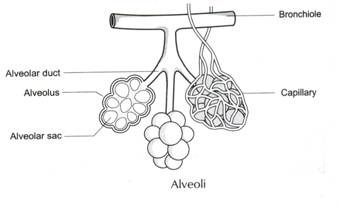
The total surface area through which the exchange of gases can take place increases because of the millions of alveoli in the lungs. Their total surface area can be about a hundred times that of the body. The large surface area allows sufficient oxygen intake needed for releasing the large amount of energy required by us.
Mechanism of Breathing:
There are two main steps in breathing: inspiration and expiration:
Inspiration:
Inspiration (inhalation) is the process of breathing in, by which air is brought into the lungs.
Inspiration involves the following steps:
i. The muscles attached to the ribs on their outer side contract. This causes the ribs to be pulled out, expanding the chest cavity.
ii. The muscle wall between the chest cavity and the abdominal cavity, called diaphragm, contracts and moves downwards to further expand the chest cavity.
iii. The abdominal muscles contract.
The expansion of the chest cavity creates a partial vacuum in the chest cavity. This sucks in air into the lungs, and fills the expanded alveoli.
Expiration:
After the exchange of gases in the lungs, the air has to be expelled. Expulsion of the air from the lungs is called expiration. In this process, muscles attached to the ribs on their inner side contract, and the diaphragm and the abdominal muscles relax. This leads to a decrease in the volume of the chest cavity, which increases the pressure on the lungs. The air in the lungs is pushed out and it passes out through the nose.
When we breathe out, not all of the air in the lungs gets expelled. Some of it remains in the lungs. This keeps the lungs from collapsing and allows more time for the exchange of gases.
Transport of Gases:
In very small organisms, there is no need to have a separate transportation system for gases because all its cells are involved directly in the exchange of gases by diffusion. However, a large multicellular organism needs a mechanism for the transport of gases for its different organs and tissues.
Human beings also have a system for transportation of gases. Oxygen is carried by haemoglobin of the red blood cells. Haemoglobin has a great affinity for oxygen—each haemoglobin molecule binds to four molecules of oxygen. The oxygen ‘picked up’ by haemoglobin gets transported with the blood to various tissues.
Carbon dioxide is more soluble in water than oxygen. So, some of it is transported in the dissolved form in our blood. Some carbon dioxide is also transported by haemoglobin. Not all of the carbon dioxide formed is expelled from the body. Some of it reacts with water to form compounds useful for life processes.